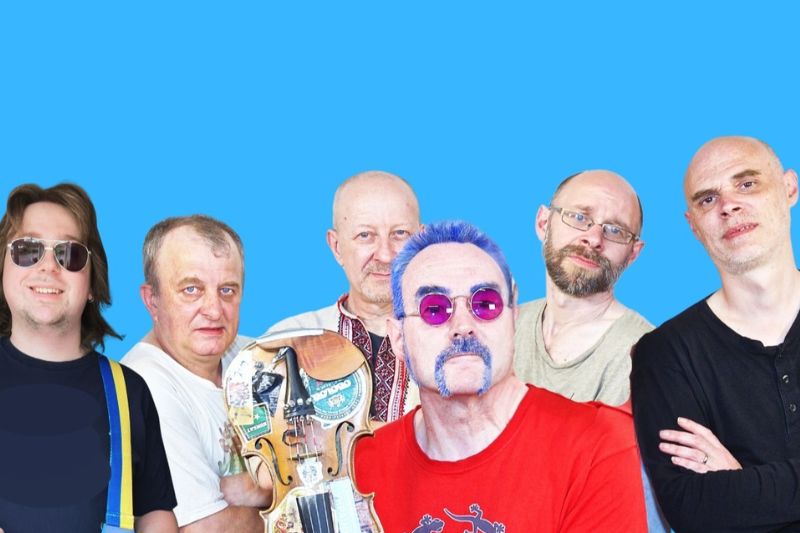
It’s some miracle they ever existed at all really, let alone made eight studio albums, played Glastonbury and performed to 50,000 people in Kyiv’s Independence Square. But that’s precisely what happened with The Ukrainians, a band conjured from thin air when John Peel requested another session from one of his all-time favourite acts, The Wedding Present.
Peter Solowka, guitarist for the Leeds indie starlets at the time, explains how those events unfolded.
“It was such a strange combination of circumstances. Back in 1986, I used to play some Ukrainian tunes at downtime during rehearsals. We started playing phrases that I could remember from my Ukrainian Saturday school days, at breakneck Wedding Present pace, just for fun. I never thought it would go any further.
“Then one day, Peel contacted us and asked if we’d do a session. We jumped at it. The only problem being we had no new songs because we’d spent most of the previous six months touring. I suggested we should test Peel’s openness. I said ‘let’s do a whole session of Ukrainian folk in our Wedding Present style, but not let him know.’ Surprisingly, everyone in the band went for it. I suppose we liked the idea of being different.”
Frontman David Gedge got sufficient approval from Peel that The Weddoes could at least go off piste for the recording and try something new but the Ukrainian theme was never actually revealed to Peel beforehand.

“We had half a dozen folk songs ready to go, because me and Len Liggins [The Sinister Cleaners] would play gentle Ukrainian tunes on violin and accordion in my Leeds bedsit.”
The beauty of the John Peel show – or one of many – was that its listeners were often as liberal as Peel himself. As soon as it was aired, there was an overwhelmingly positive response to the Ukrainian-themed Wedding Present session, with swift requests for another.
“I think we expected it to be just a flash in the pan, a one-off that everyone would forget about with the next release by The Wedding Present. But it wouldn’t go away. It became one of the most requested Peel sessions. We did another and the two sessions were released as an official Wedding Present 10”, which reached number 22 in the national album charts. I think we beat Kylie that week!
“The Wedding Present actually toured it, supporting themselves with a normal Wedding Present set. It was beginning to have a life of its own. Even when we signed to RCA, there were clauses that allowed or expected us to release another Ukrainian album.
“Being poetical about it, it’s like this seed of Ukrainian folk rock music was planted by John Peel and The Wedding Present, then grew in the fertile ground of perestroika-infused western liberalism. Not only in the West, but in Ukraine too. I remember going to Kyiv in 1990 and people proudly showing me their cassette tapes with recordings of the Ukrainian Peel sessions. It was amazing!”
The band were the first to fuse Ukrainian-language folk with western indie and present it back to the world. And audiences lapped it up. Tours across the UK, Germany, France, Poland, Spain, Netherlands and Canada followed, including slots at many of the world’s most prestigious festivals. The band’s popularity grew and grew. They played Womad. They wrote the music for a Nike advert featuring athlete Segeri Bubka. They’ve even had their music played on the International Space Station.

“As a group, we are pretty unique. Some of the of the band members have a Ukrainian background, and we choose to sing in that language. Surprisingly though, the majority of our followers are UK based folk and world music fans.”
The Ukrainians are masters of re-invention, taking old traditions and bringing them to life for a modern and very different generation of listeners. Most of the band’s material is self composed, but they also are known for their unique covers, including Ukrainian language versions of western classics by The Smiths, The Sex Pistols and Motorhead.
“I’ve always thought of folk music as the tunes that everyone knows. You get introduced to them when you are pretty young and they become part of your identity. They’re a reference point to which you can compare new music. So in Britain, to me, The Beatles are part of folk music. But when people were defining folk music in Britain, it was happening in the Fifties and Sixties, so the vocal styles and instrumentation reflected pre-rock ’n’ roll. So, no electric instruments or heavy drums, just guitars, fiddles and voices. Many people researched and recorded old, dying songs while others composed new material in this old style. These folk musicians are no different to any other artists who choose to compose in a particular style – like metal, hip hop, or disco – styles just like folk. I respect them all.
“But with Ukrainian folk music, the story is quite different. Ukraine has had very few periods of independence. This one is now longer than all the others put together. In a world before the printed press and literacy, it was music that gave people their common identity. Folk music was the means through which people celebrated family events, sang ballads of heroes, sad songs of war and loss, and expressed resistance and desire for freedom.
“In the face of foreign domination, it was the music that preserved the identity of the people. Growing up in the West, we were very aware that we could sing and dance and express ourselves in a way that Ukrainians under the Communist system could not. I was constantly told by our community that it was our job to preserve these traditions to help keep Ukrainian independence a possibility.
“When independence finally arrived in 1991, an enormous amount of music came out of Ukraine. It was now OK to sing and dance and perform using Ukrainian, with Russian being the official language. In the early Nineties, thousands of CDs were produced across the country, by young bands from the cities right through to groups of grannies in the villages, and all this music is clearly recognised as Ukrainian due to the style and content. The music really has helped bind the country. So much of Ukraine’s pop music still has references to the old village styles. In Ukraine, X Factor and The Voice regularly have artists re-interpreting the old songs. Ukraine’s Eurovision successes are all folk based, and now, sadly, during the war, those styles are used to mourn and express hope for a peaceful end to the conflict.
“So Britain’s experience of folk is that it is one style of many in our cultural melting pot, but for Ukrainians it really is a cornerstone of identity.”
Of course, a lot has happened in Ukraine since the band started, from struggles for independence, western cultural influence, the problems of migration and most recently, the Russian invasion. The music has often evolved too, reflecting those seismic changes.

The title of their latest album Liberatdsiya, meaning ‘liberation’, is inspired by Ukraine’s recent struggles to remain free of the domination of its old enemy.
As detailed in the press notes for the album’s release ‘Liberation’ also “acknowledges the need for all people to be able to express themselves through their own culture without interference by outside agencies – something that the people of Europe have struggled for and benefitted from for generations.”
For more information on The Ukrainians, check out the band’s website.
– – – –


Leave a Reply