“I’ve been told by various people I have a few northern, battle-axe characteristics”
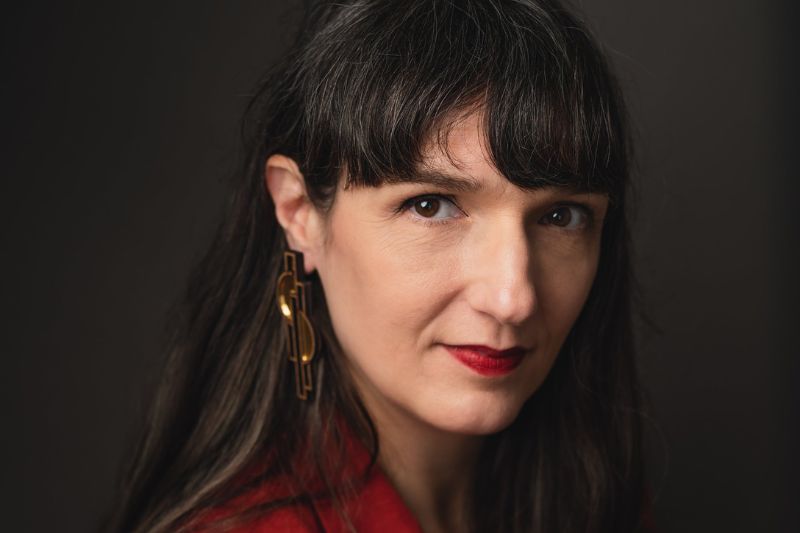
When you’re starting a website like Dirty Sunbeams, based on music culture in the north of England, there are few names more befitting of its combined subject matter than Calder Valley resident, Adelle Stripe.
Born in York in 1976, the year British punk first reared its head, Adelle’s first love was music, not books. From an early age, she feasted on everything from hip hop to metal, discovering sounds from across the globe – her northern roots remaining strong throughout.
Today, you’d be hard pushed to find a writer more skilled at depicting working class life in northern England. Her debut novel, Black Teeth and a Brilliant Smile, a fictionalised biography based on playwright Andrea Dunbar, was a gritty-yet-tender rampage through a boozy, belligerent Bradford. Published in 2017, it was shortlisted for the Gordon Burn Prize and Portico Prize for Literature.
Five years later she tackled a somewhat different subject. Her biography of indie-rock insurgents, Fat White Family, Ten Thousand Apologies, co-written with lead singer Lias Saoudi, charted the chaotic ride of one of the UK’s most controversial bands of recent times. It was a vivid, raw, hilarious account; a tear-up of the band biog textbook – and became a Sunday Times bestseller.
The two works, varied in topic, are held together by plenty of common threads: self-destruction, rebellion, fragility, greed, comedy, popular culture.
Finding a quiet moment in her busy schedule, we put some questions to Adelle to find out what sounds (and visions) fuel her creative energies.
– – – – –
DS: Adelle, which bands first gripped you and how have your musical tastes evolved?
“The first record I bought from a shop was on a trip to the Arndale Centre, which felt very exotic at the time. It was 1989 and Manchester was popping in comparison to dreary old Leeds. It was a 45″ of Three Is the Magic Number / Buddy by De La Soul.
I had older friends who would pass cassettes onto me, taped from the radio, so I listened to various genres, from rock and metal – Guns ’N’ Roses, Napalm Death, Iron Maiden – through to hip hop – 2 Live Crew, Betty Boo and Salt-N-Pepa – and indie – REM, Violent Femmes, The Smiths. But my main love was punk, so as soon as I was old enough, I started buying singles from car boots and charity shops. I liked Buzzcocks, Joy Division, X-Ray Spex and Siouxsie and the Banshees.
By the age of 16, I was going to gigs every week at the Duchess on Vicar Lane, watching bands like Blur, Elastica and Pulp, and I was a diehard Suede fan during the Bernard Butler years.
I was always interested in what had gone before and became a regular at [Leeds club night] Brighton Beach. They played all sorts of wonderful music from the 60s – freakbeat, psych and rhythm and blues – which informed my taste.
By the mid to late 90s, I was listening to jungle, drum & bass, trip hop and house/techno. I became a huge reggae fan around that time and eventually started promoting when I moved to London, where I became a music programmer at a venue on Brick Lane. I’m definitely a grazer when it comes to music, open to all genres and suggestions.”
DS: Who are the most talented lyricists you’ve encountered? And what sets them apart?
“Tom Waits is a personal favourite as he creates characters and scenes with his songs that transport the listener into another world. Leonard Cohen is another. I love his use of image and reserved emotion. Both have literary leanings, rather than just songs with words tacked on as accompaniment. Their words stand up on the page and can be read as well as heard. That is what elevates them.”
DS: You’ve admired some edgy, brave artists. Is such gravitas something you’re drawn to? And is it more rare in musicians these days?
“Young people face pressures which our generation never had. We could make mistakes, mouth-off, make regrettable choices – but little of that was recorded, filmed or tracked. There is an anxiety now about public perception that didn’t exist in the pre-digital age.
What was permittable behaviour – and humour – back then would not be acceptable in 2024. Pop stars were given a weekly platform in the music press, and honed their interview skills to such an extent that they knew an outrageous, outspoken front-page splash would guarantee publicity and sales. There is now a worry of saying anything that attracts attention for fear of online reprisals.”
DS: Were you in bands growing up, or did you ever come close?
“I played rhythm guitar and was quite competent for a while but never made it onto a stage. There was a group of local dropouts called The Pins back home who were a bedroom band. I played spiky guitar with them and wrote the lyrics and can still remember one of the songs:
I watch SKY TV and I drink Stella beer
I smoke 25 fags because 20 are too dear
I used to hang around TadKebab, but now I go to Merlin’s.
I always drive an XR3i and use the backseat to hurl in.”
DS: You identify strongly with your northern roots. How has that regional influence shaped your personality and your writing?
“Most of what I write is set in the north, as that’s the language and culture I come from, and I think it’s a bit neglected in the literary world. I don’t know how much being from here has influenced my personality, but I’ve been told by various people I have a few northern battle-axe characteristics.”
DS: Are literary awards more valid to writers than music awards are to musicians?
“Yes, because we tend to have very low advances, so unless you sell a huge amount of books, it’s hard to make a living from this profession. There were 188,000 books published in the UK last year, so any kind of recognition via an award helps shine a light on the work you create. It’s not like we can go on tour, performing to audiences every night, unless you’re an extrovert, which most writers aren’t. Writing is a solitary life and, on average, we earn far less than minimum wage for our efforts.”
DS: What are you currently working on?
“I’ve been writing a few reviews for Record Collector recently, and have a radio drama project on the boil, which may or may not see the light of day. My new book comes out in February on White Rabbit. It’s called Base Notes: The Scents of a Life and it’s about perfume and memory.”
DS: Could you offer a few words of advice to aspiring, passionate creatives?
“Be the Jack Russell tearing at the postman’s trouser leg. What I learned on a so-called ‘Mickey Mouse’ media studies course at Art College has given me skills that I still use today, all these years later. Editing, writing, journalism, photography, filmmaking, production, graphic design. I have used elements of these in every job I have ever had, so don’t listen to those who say you ‘need to get a proper job.’ Keep at it, keep going and develop your own unique style. The greatest artists and creatives have a singular vision and learned early on how to be independent and embrace the DIY mindset.”

On The Spot – A Two-Minute Mini-Interview
Sunrise or sunset?
Sunset
Best gig you’ve ever been to?
Prince at Manchester Arena
Do you believe in ghosts?
Yes, but in a positive sense. I am followed around by the ghosts of people I have loved and lost. They don’t wear white sheets.
What was the last band t-shirt you bought?
I don’t wear band t-shirts but I did buy a Rita, Sue and Bob Too t-shirt rendered in the style of Sonic Youth’s Goo from a bloke who printed them in his garden shed in Bradford. Does that almost count?
Given unlimited super-powers, what three things would you do to improve the world?
Build social housing, including temporary chalets or statics, in every town for those in most need. Take all public transport into government ownership. Invest in adult education and bring back art colleges.
If you were to start a band right now, who would be in it and what would it be called?
I was joking with David Keenan about this at bluedot Festival. He wrote a brilliant book called This is Memorial Device and sitting beneath the Jodrell Bank telescope in the festival rain, we decided our band would be called The Tragic Deckchairs, with a UFO-themed concept as our debut EP, called Is There Anybody Out There? I’m thinking outer space-dub here, so I’d have Keenan on lyric-writing duty, then Moondog on percussion, Florian Schneider on keyboards, Family Man on bass, Aisha on vocals, Mad Professor on mixing duties and Robert Fripp on guitar.
Realism or idealism?
Realism every time.
Tell us about one of your favourite artists most people have never heard of?
Brenda Ray is an unsung hero of post-punk and one of the north’s most original and neglected cult artists. As part of Naffi Sandwich and Brenda and the Beachballs, she set up her first studio above a barber’s shop in Newton-Le-Willows on the Manchester-Liverpool border in the late 1970s and created a diverse catalogue of lo-fi music influenced by reggae, exotica and funk that sits alongside The Slits, Raincoats, Flying Lizards, PiL and Kleenex but is rarely discussed alongside these innovators. I hope a Brenda revival will happen one day, because her music is quality.
—
With big thanks to Adelle Stripe for her time and efforts. Follow Adelle on Instagram and find out more about her forthcoming memoir, Base Notes.
Photo credit: Carolyn Mendelsohn