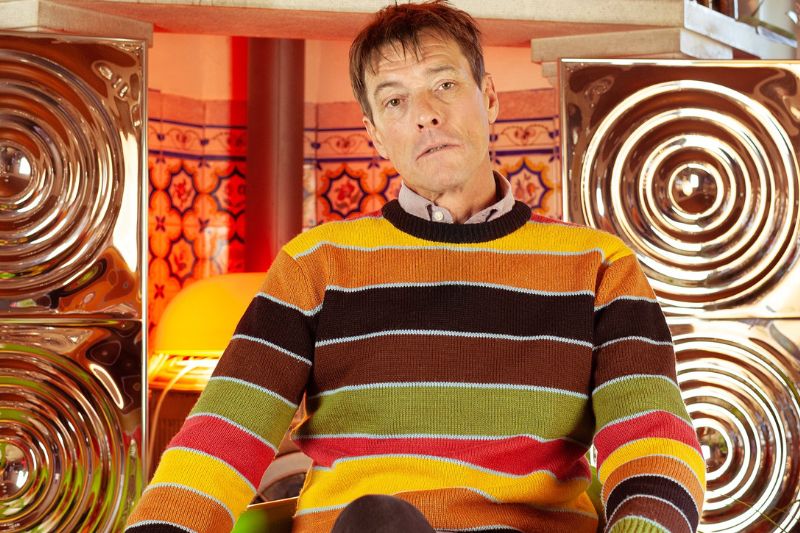
Following Spacemen 3’s feisty split in 1990, the band’s two chief protagonists Pete Kember and Jason ‘Spaceman’ Pierce drew up the barricades and went their separate ways, musically as well as personally.
Jason found solace and inspiration in his gospel-dappled drone-rock extravaganza, Spiritualized. It’s been his primary creative outlet ever since and birthed innumerous glories, most famously the epic Ladies And Gentlemen We Are Floating In Space.
On the other hand, Pete Kember’s journey has, eventually, taken a more unpredictable route. Initially, his solo work seemed a gently experimental progression of Spacemen 3, by and large leaning reliably on the ambient drone-pop formula he perfected on his side (side A) of the band’s final album, Recurring.
Venturing into the 21st century, Pete spread his wings and began to explore new territories at a pace. He has collaborated with everyone from Beach House and Stereolab to MGMT and Yo La Tengo. Recently, he has struck creative gold by partnering with Animal Collective’s Panda Bear, the two of them drawing on all manner of genre influences to fuel their fire, including Sixties girl groups, dub and even mariachi.
His latest excursion is a Christmas album – or should I say “holiday” album – called A Peace Of Us, which he’s made with long-time friends and collaborators Dean and Britta. It seemed a good place for our interview to start…
So, ‘A Piece of Us’. You’ve made a Christmas album?
Pete: “I have an aversion to even saying ‘Merry Christmas’. It’s a load of bloody nonsense. Christmas is an entirely Christian thing, which is a dogmatically-repeated piece of craziness. I don’t believe that the guy who was born of a virgin who had two older brothers, you know, somehow his mum was still a virgin, with the immaculate conception, and he rose again from the dead. I don’t know if I really believe in this.
It also makes me very sad that for a few days people are forgiving and philanthropic and feed the homeless and stuff. It’s a vibe that really we should carry all year, every year. But, I’ll take it over nothing.
But there’s something about the holidays. I think it can be really magical for kids. And I do like Christmas records. I like the instrumentation, the sleigh bells and stuff. Even on the Reset record I did with Panda Bear, we used sleigh bells all over it. They have this really crisp, lifting vibe.
So anyway, yes, I spent the summer working on a Christmas record in the sun in Portugal, which was quite surreal. It would have been nice to have gone to Lapland or somewhere.
It’s meant to be a holiday record but some of the songs are not traditional. If We Make it Through December. The single Pretty Paper was written by Willie Nelson about a Vietnam veteran with no legs who, instead of begging, would sell ribbons and paper outside department stores.
We do Little Drummer Boy, but we do the Bowie and Bing version where it has the Peace on Earth song woven through it very artfully. It’s a really nice arrangement those guys came up with.”
You’ve been drawing on some really interesting and diverse influences the last few years. Looking back at the span of your career, what would the late-80s Pete Kember of Spacemen 3 have said about the Pete Kember of today?
Pete: “He would have been mortified by some of the records I listen to now. I mean Reset was really influenced by bubblegum.
When I moved to Portugal, it’s just such a beautiful environment, I wanted to re-experience all my old records. When my album, All Things Being Equal, came out, it was right at the start of the pandemic. It was very inspired by the fact that I sensed we were on the the brink of a disaster. I thought I should say something about it, but also create positive songs. I couldn’t have hoped for a better audience for that record.
I then had this idea, working with Panda Bear, about taking intros from records. So I made all these loops. He then wrote his song to the loops and I was just so impressed. I couldn’t believe what he sent me – one song, another, one, another one. I was like ‘OK, let’s really juice this and push every sort of joy button and make something to really lift people’. So I started listening to stuff and noticing I really just love a lot of this bubblegum stuff from the 70s, middle of the road, and I know the 18-year-old me would have been ‘This is not The Stooges. This is not The Velvets.’
We live out in the countryside in Portugal and we were kind of left to our own devices mostly. We did what the fuck we wanted. And I had a friend there who has a record store at his home and I’d go up and buy things like Adam and the Ants’ Kings of the Wild Frontier album. If my 18-year-old self had known that I would ever buy that record or, like Sandinista, by the Clash… I never had a good relationship with that record when it came out. I can see why it was tough for me because the scope of that record, it covers so many genres and it’s constantly twisting and turning.”
But is that because, as we get older, we don’t care so much about image, how we might appear or fit in?
Pete: “For years I went out playing Spaceman 3 songs. I did it for decades. Then, one of the pivotal moments for me was MGMT, at the peak of their success, asking me to produce them. It made absolutely no sense, which is why they did it, of course. They were like ‘fuck you’ to the record company. Those guys did so many things. They wanted to use a gated reverb. I mean that was a crime from the 80s, but then they’d do something with it and I’d see I was wrong. It taught me this lesson that you don’t know everything.
Because of working with them, I worked with people like Panda Bear, Beach House, Iceage. Really different bands. I learned something from all these people.”
Your recent records have shown a deeper interest in global issues and philosophical matters. Where has that comes from?
Pete: “I think it’s a lot to do with the things I grew up with. I was never a massive Beatles fan but over the years I got into some of The White Album, Helter, Skelter and the sort of proto-rock thing they invented and the psych stuff.
For that band to totally rewrite the rule book of music at that time… I’m sure the record company considered it absolutely suicidal. Then they come out of it with this really benign sort of vibe. I mean, George Harrison and John Lennon particularly had this really beautiful vibe.
Of course, I listened to Imagine for years, but I didn’t ever really quite absorb the lyrics. ‘Imagine no religion, imagine no countries.’ It’s so amazing that this guy, who was basically a sort of brawler from Liverpool, suddenly, through Yoko – but I think with psychedelic drugs as well – decided he had powers and wanted to use them for good. That was really influential on me. There’s a way to do it without being preachy.
I think humanity is motivated mostly by two things: punishment and incentive. The incentive being money, usually. But the third possibility is aspiration. And that’s what The Beatles were doing. They were trying to get people to aspire to things for the right reasons. There was no punishment, there was no financial benefit, it was just like the right mindset to have and a good moral compass.”
What are your thoughts on the power of music and substances to heal?
Pete: “I think the psychedelic experience is as deeply complex as DNA. It makes no sense that a plant or something would make that depth of experience just to stop you eating it again. Going back to polyps growing in the sea billions of years ago, they were psychedelically sentient.
When you look at how humans interact on this planet, we think we’re the boss. We’re not symbiotic with anything. We think everything else is stupid and non-sentient. That makes no sense. Panda Bear’s kid was at my house one time. We were in the garden and he says, ‘Pete, do plants fart?’ I said, ‘not only do they fart, but that’s what we breathe.’ Without plants farting we have none of this, this magic, this…
We don’t teach our kids these important things. Changing educational systems is really hard, but the way we educate our kids is built to fail – to aspire to a big house and a big car and be rich. None of those things will make you happy. We’re seeing the planet getting ruined by bucket lists and influencers preying on bucket listers.”
Was that the reason for donating money from Reset towards organisations like MAPS (Multidisciplinary Association For Psychedelic Studies) and Earth Institute?
Pete: “I felt the more we tried to give money away with that record, the more successful it was. The Honda advert, which was a lot of money – it was great thinking that a third of that money that Honda were paying was going to help fix people who were traumatically stressed.”
Do you think lockdown has forced a ‘reset’? Do you see positive change coming out of it? And are music or substances a part of that?
Pete: “Half of people went one way and half went the other. I live in one of the most beautiful places I’ve ever been in the world and I’ve travelled a lot through working. There’s a lot of very psychedelically sentient people that instantly see the place and somehow recognise they want to be part of this beautiful, relatively unspoiled environment, and I think that comes from minor psychedelics like weed. It can open your mind to seeing things in a different way.
It was always very useful for me working on records and when the record was done, my check would usually be to smoke DMT and listen to the record because it just smashes your memories and perception of everything and you’re experiencing it with a whole fresh mind.
I even do it with record sleeves where I’ll get myself psychedelicized to see how the thing looks and to feel it. You know, the same way as an acid tab. The picture on an acid tab is really important to what’s going to happen in your trip, the colour of it.
The guy who does all my packaging, Marco Papiro, actually works on pharmaceutical packaging and says it has to be generic. You cannot try and influence anyone in any way with the packaging, but you can with the colour of the pill.
In the same way as the picture on an acid tab is really important, what’s on the front of a record is going to affect the way you experience it and what your possible expectation might be.”


Leave a Reply