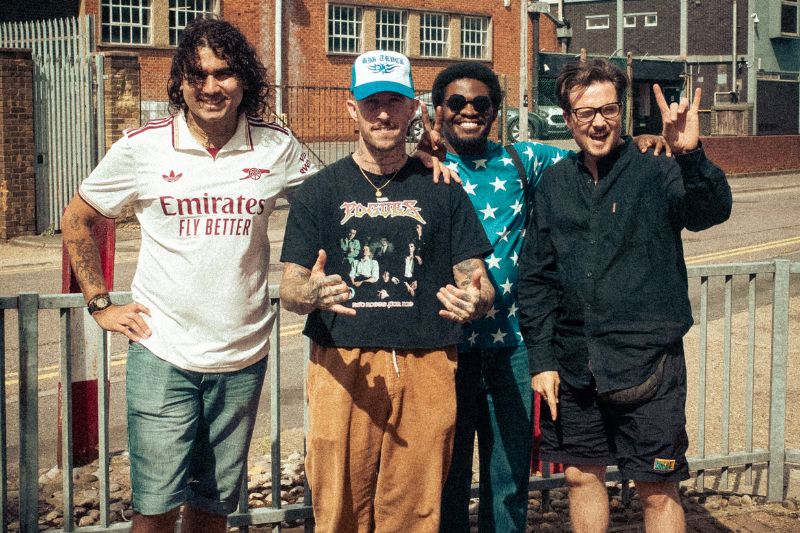
The following article comprises a selection of anecdotes from a Q&A event with James and Nick of The Coral. The evening, at Square Chapel in Halifax, was one of several on a short UK tour and featured acoustic songs, compere-led discussion and audience questions.
A book was published to accompany the tour. You can buy a signed copy here> (this is not an affiliate link)
– – – – – – –
The early years on The Wirral
James Skelly: “I was living in Hoylake. My dad had a burger van and, in winter, there was not much money coming in, so he started managing a pub in Birkenhead. That’s where me and Ian first started creating our own world really.
There were DJ booths in every pub, with vinyl, 45s. We started a DJ combo called TNT. I think we were 12 or something. We did a few birthday parties. Then we moved to a pub near the old raves. We were the pub that everyone would stop off at on their way home. So on a Sunday, my dad would get us to DJ. It was my first taste of adulation. Now I know why they were all dancing!”
Nick: “At that age, my biggest memories were football, driving round in my dad’s car to Sunday league football pitches on The Wirral. Once, a police van drove on the pitch and arrested the striker. My dad was into The Specials, Jamaican music, Lee Perry. At that time, you were either into Nirvana or happy hardcore. Then I woke up one morning and heard Oasis and it just cut through and unified everything.”
James: “Yeah. Suddenly, overnight, everyone had Beatles haircuts and there was this wave of nostalgia for the Sixties – The Kinks, The Animals, Small Faces.”
The beginnings of a band
James: “One day I heard Ian [Skelly – drums] and Paul [Duffy – bass] messing about with this massive kit and a Spanish guitar. It was just weird. But the music teacher saw something in them and gave them time to work on it. The band then soon ended up with Ian, Paul, Bill [Ryder-Jones] and Lee [Southall]. They were all in the same year. Bill was already really good. He had a quiet determination.
I’d left school with no GCSEs. I gave my GCSEs to my mum and she put them in the drawer and we never spoke of it again. She made a haunting sound that still reverberates to this day. I looked at the college courses and saw ‘leisure’ and ‘tourism’ and thought ‘I could get with that’. But it was shite really. I just stopped turning up.
I wanted to get into music. I remember Noel Gallagher saying he wrote Shaker Maker off the back of the Coca-Cola advert. I saw an Alton Towers advert and wrote a song called Rollercoaster. It’s one of the worst songs of all time. But I’d started. I was listening to The Jam a lot and wrote a tune called Billy Much that I could only sing in Cockney, which worried me mum for a bit. Then I was on the bus listening to La-La-La Lies by The Who, and I just started changing the words. That turned out to be Pass It On.”
From four to six
Nicky: “John asked us over and I wafted my way through the smoke. It was like stepping into The Goonies. Or The Garbage Pail Kids. They had their own language. They just didn’t care. In the first three days of hanging out with them, I starred in my own version of Easy Rider, shot on camcorder, called Lazy Rider. It was a world within a world and everything I wanted. I was playing football at the time and I was due to go on this tour of America. I told them I’d given up football and joined a cult. I never played again.”
James: “I was in other bands but always wanted to join them, The Coral. Everyone did. Ian could play. He used to rehearse to Who records. Bill was already a prodigy. Paul’s mum taught them all harmonies. Lee’s dad played with Merseybeat bands and Lee could play in this amazing lost Fifties style.”
Nicky: “Any band at that time had to go to Liverpool to earn their stripes. So that’s what we did. His mum and dad had a pub in Queen’s Square called The Rat & Parrot, on three floors. To pay rehearsal fees, we had to take a job in the pub, glass collecting around the steroid-heads. We did that for two years.”
James: “I saw the band Tramp Attack near there. It’s still the best gig I’ve ever seen. Dave McCabe was in that band. Dave from the Zutons. I met the band afterwards and I just really wanted to be a part of all that. It introduced us into the Liverpool scene. That garage sound in Liverpool at the time was a reaction to Britpop, which had become overblown and too self-important. We wanted something more real. It all centred around the Zanzibar club, and a night called The Bandwagon.”
On Alan Wills, manager and mentor
Nicky: “Alan was a huge influence. He was the drummer in Shack and had managed four or five bands. Ian drew a poster for a gig we had. It was a picture of his grandad with his head lobotomised and a dream universe escaping. Alan said he came to see us on the basis of that gig poster and didn’t even need to hear us.
Alan wasn’t taken that seriously by other people but we loved him. In the first five minutes of him coming into the rehearsal room he talked about his beard, Serbian cinema and Edwin jeans. He was manic. Like we were. He loved everything. Like us. He opened up our world.”
James: “His reaction to songs would become addictive. If he liked it, he’d start running on the spot. So you’d want more of that. You’d want to write another good song that made him do that. He encouraged the darker stuff we were doing. He probably said the doo-wop stuff was too Happy Days.”
Finding a unique sound
Nicky: “We got a matinee slot at The Cavern. We’re still waiting to get paid for that. Town was closed back then and you’d see Mick Head from Shack, or Pete Wylie, all these other musicians around town. We’d play at like 12 o’clock and 4 o’clock to a few Japanese tourists. We’d play the old Beatles songs, which are really hard to play, but we were really good. It was like our Hamburg.
Beefheart was a big influence back then. We all went back to Paul’s to listen to Beefheart for the first time and light bulbs just went off in all our heads.”
James: “I got a CD with this Beefheart interview on it and he’s asked ‘what key is that song in?’ And he just said ‘skeleton key’ and that’s when we wrote what was probably the first real Coral song, Skeleton Key. Only The Coral could have written that.
But then we played this battle of the bands and Tramp Attack won. I remember thinking, we’ll never beat them at this Liverpool thing. Alan told us to take a year out and find our own thing, our own sound.
We then had this revelation to cross the eccentric, psychedelic welsh thing – Gorky’s Zygotic Mynci and Super Furry Animals, stuff that Dave McCabe had introduced us to – with the Liverpool beat and harmony sound. We saw the Teardrop Explodes album as the thing that brought them together. Then, almost as an exercise, we wrote a song about Simon Russell, who worked in the pub, this northern Irish guy with a head shaped like a diamond. He probably deserves a song credit.”
Signed and scene
James: “Ian and Nick had got the chords to Shadows Fall. It had this jazzy drum beat with the brushes. No one else in our scene was playing the brushes. Lee added this Egyptian guitar. Bill added this dub soundtrack, Ennio Morricone thing. Me and Nick went down to the shelter on the beach to write the lyrics, which had everything in it – our friendship, our loves, our personalities. That’s why I still think it’s the ultimate Coral song. We played it to Alan and he was barking like a dog, running on the spot.
James: “Alan created the label Deltasonic around us. Then he sent us to The Motor Museum recording studio with five sleeping bags, six pot noodles, some Snickers and a bong. Three days later, I had this rash on my face from sleeping on the floor, Paul was inside the bong and we had the Shadows Fall EP.”
James: “It then became a bidding war with the labels. Rob Stringer from Sony came in and it was obvious he was the best.”
Nicky: “Because Lee, Paul and Bill were so young, their mum and dads had to be there to sign the contract.”
James: “We were put up as one of the spearheads of this reaction to Britpop. It was us, The Streets, Ms Dynamite, So Solid Crew, The Bees.”
Nicky: “So Solid Crew beat us 6-1 in a charity football match. At Anfield. It’s still my most humbling experience. They had Ian Rush and we had David Fairclough.”
The debut album
James: “Ian Broudie wanted to produce us and he became a really good life mentor to us. He was like a doctor of pop. In a Sixties way. We were like an uncut diamond. He would say, ‘shave this chorus off, put this there, and it’ll work’. He made it more mathematical. He’d get something like a vibraphone and leave out in the studio, knowing Bill or someone would pick it up and get something going from it. We did all live takes. And never more than three takes.
Dreaming Of You wasn’t initially going to be on the record, which seems crazy now. We were going to save it for later. Then Broudie said: ‘There is no later, there’s only now’. So he suggested we record it anyway and he just captured it great and no-one could deny it.”
Nicky: “We loved The Beta Band and we thought if the album is as big as The 3 EPs we’d be really happy. But it went much bigger than that. We became part of a bigger thing.”
James: “It sold about 700,000. If we’d promoted it properly it could have done more. But we wanted to move on. It was the arrogance of youth. Top of the Pops was when we felt we’d made it. You’re in the public consciousness then. We played live.
Then we got a phone call about the Mercury Music award. I didn’t know what it was. I thought it was something to do with Freddie Mercury. Everyone was excited and we got invited down but didn’t go. I think we told them we were booked to watch Saw 3 at the multiplex. We didn’t get it. So we rented a hotel in the centre of Liverpool and got in the jacuzzi dressed up smoking plastic turd cigars and got Paul’s brother to present us the award dressed as Freddie Mercury. That’s the only reason we’ve never been nominated since. Nothing to do with the music.”