“We have a new-found confidence. We no longer wait for genius ideas to descend before we enter the studio.” – Martin Bramah
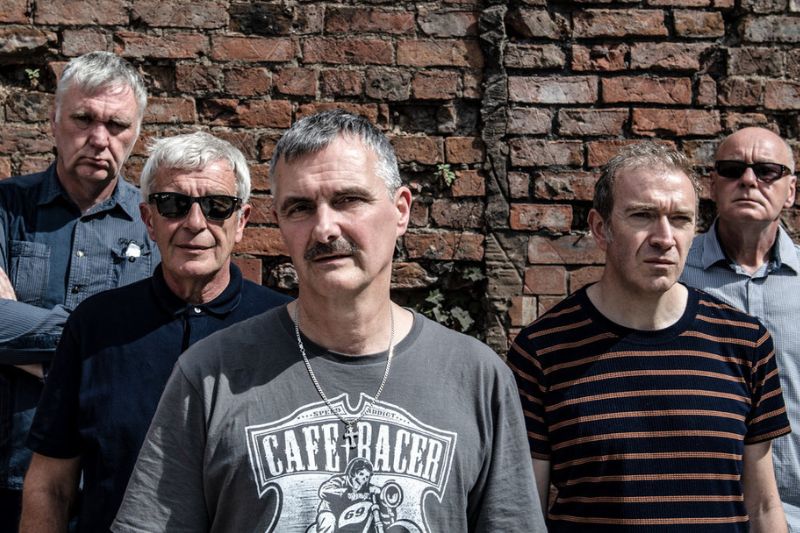
There’s a running Northern joke that you’d be hard to come by anyone in Manchester who hasn’t been in The Fall. Over 40 years, the band cycled through over 50 musicians with varying talents and varying time spent with Mark E Smith, the constant face of the band. Now a select few have come together to form House Of All.
The grimy, melodic sound of The Fall has a reach like no other. The gruff spoken-style vocals and hypnotic guitar sections are a constant inspiration for modern musicians. ‘Post-punk’ is a broad term but each new band carrying that label will almost certainly give praise to The Fall – you’ll often find that identifiable powerhouse melody and Northern identity present in new releases. The Fall certainly pioneered an impactful and increasingly important era. And House Of All aim to honour that legacy.

House Of All consists of Martin Bramah (guitar and vocals), Stephen Hanley (bass), Pete Greenway (guitar) with Paul Hanley and Simon Wolstencroft, both on drums. Their self-titled first album was released in 2023 to a mostly positive response – except for the family of Mark E Smith. Quickly, House Of All encountered a backlash and accusations of exploiting Smith’s image. Whether true or not, it does beg the question, ‘How do you create a new sound while being consistently placed in the shadow of one of the most revered and genius minds of post-punk?’ Bramah said from the start he would never attempt to replicate The Fall but instead use the creative tools passed from his time in the band to facilitate his new working process.

It was after moving back to Manchester when Bramah had the desire to conjure up a new project with some familiar faces. With time and a chance encounter with Wolstencroft, House Of All was formed.
Despite decentering Mark E Smith from the new band, they did want to recreate his infamous creative process. A high-pressure and often tense environment was credited with producing some of The Fall’s most iconic tracks. Often arriving in the studio with incomplete concepts, the band was forced to adapt. Evidently, such urgency still works for House Of All, who have released an album a year so far. Their most recent, Inklings, released in March, is followed by a UK tour.
Ahead of their Trades Club show, I asked Bramah a few questions, ranging from the album’s creative process to The Fall’s undying legacy.
While creating Inklings, what were some of the processes that you kept from your time in The Fall with Mark E Smith and did you introduce anything new?
M: We have kept a sense of being in the moment and thinking on our feet. In The Fall there was always a strong element of having to listen to someone’s rough idea and figuring out how to respond musically. Songs would rarely arrive complete, with a given part to learn. This has made us adept at spontaneous composition. We have a new-found confidence in this process and have developed it into a working method. We no longer wait for genius ideas to descend before we enter the studio. We just book time and work with whatever comes to mind on the day.
What would you like listeners to take from the new album? What overall message did you want to put across?
M: Take what you will. The real message is subliminal. We work with the subconscious. The message is a puzzle; to reveal it would spoil the whole point.
The Fall is continuing to inspire a new generation and wave of musicians. Why do you think The Fall has had such a lasting impact on music?
M: The Fall had an authentic voice. It was a genuine form of folk music. We were not a music biz creation. There was no compromise with business pressures. Mark E Smith, in particular, lived a unique life in music. He had an insightful and true working class voice.
Similarly, what are your thoughts on the current post-punk scene – especially the Manchester scene, which still credits a lot of its creative inspiration to The Fall?
M: I don’t really have any thoughts on ‘post-punk’ 50 years after the event itself. Good luck to anyone that’s driven to do their own thing. It’s a rocky road, that’s for sure. I’m always interested to hear new voices from the grassroots, whatever label they are given.
In regards to new bands, do you have any that you’re especially fond of or ones that you dislike?
M: I like Cindy Lee. Are they still considered ‘new’? I dislike AI pop on principle.
With your upcoming Trades Club gig, how have independent music venues impacted your life and career?
M: Independent venues are the beating heart of the scene. Without them, all would be lost! They have given people like us our platform from day one. They bring an invaluable community spirit to any town that can sustain them. Long may they thrive and be valued. The Trades Club is a great example of this tradition.
Did you have any music or media that was especially important to you when creating the new album?
M: ‘Thus Spake Zarathustra’ by Nietzsche.
What’s your favourite aspect of live performance?
M: Bending the crowd to my will. Crushing dissent with a whisper.

Leave a Reply