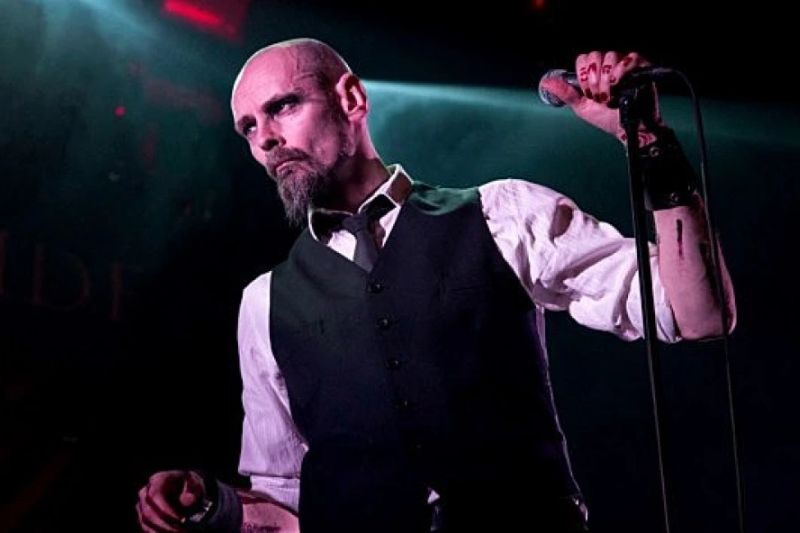
High Parasite frontman, Aaron Stainthorpe, is no stranger to the Calder Valley. He lives in Halifax, so the Grayston Unity is a familiar place to him.
“I’ve been there loads of times, so I appreciate it’s not the biggest venue in the world. I tried explaining it to the rest of the band and they couldn’t get their mind round it. I suspect that High Parasite might be the noisiest band to play at the Grayston. I told all my friends who are coming to bring earplugs, because it’s going to be a hot, sweaty racket, which is what rock and roll should be.”

High Parasite are also set to play some incredible festivals this year, including Tolminator Metal Fest III, and have played Damnation Festival, and toured the UK with Cradle of Filth. So they’re pretty used to playing high production gigs. However, Aaron, who has also made numerous appearances on other records, such as Disincarnate’s Dreams of the Carrion Kind, has a humble nature and won’t turn his nose up at playing a small capacity venue in the name of Goth Festival.
Aaron’s journey in death metal and goth culture has been evolving for over 33 years, since the time when My Dying Bride formed. Aaron loved Depeche Mode, who ended up being one of the starting points.
“When we formed My Dying Bride, I wanted elements of goth, not just metal, but elements of goth in with our metal, just to mix it up a bit, because I thought those elements would work well together. That was 34 years ago and I’m still mixing it up with High Parasite, which is much more, dare I say, radio friendly. My Dying Bride songs are 10 minutes long. They’re sometimes written in Latin or French. They’re difficult to get into, but they’re deeply emotional. With High Parasite, I’ve gone completely the opposite way and we’ve written three-and-a-half-minute songs, which are a punch in the face. We’re not reinventing the wheel, we’re just having a good time.”
Being part of a scene for so long is impressive to say the least. It’s inevitable to see evolution in these things over such time – especially with the rise of online spaces and streaming. Goth culture has changed since the underground origins of the late 1970s with punk and other youth subcultures. Depending on where you are in the scene, you could argue that it’s partially merged with diverse elements like vampire and Victorian fashion, cyber and industrial style, and neo-folk trends, along with the more mainstream, new metal alternative bands. Aaron recognises that.
“It just goes to show that people have taken the heavy metal element and they’ve really run with it and expanded all of its borders in many different directions. It brings in a broader appeal to a wider audience, which is only a good thing. We want more people involved with our scene, rather than less, of course, and so we work hard to try to diversify a little bit and bring different elements into our music.”
Aaron went on to tell us about a recent experience he had, where such differing worlds collided.

“Just a couple of weeks ago, I did a poetry reading in a church in Antwerp and then I sung a couple of songs, accompanied with a grand piano, a cello and a choir. It was not heavy metal whatsoever, but it was magnificent in its impact and the people who were there were overwhelmed. They were crying, for good reasons, and I wouldn’t have been able to do that 20 years ago. It would have just been mind-blowing. But these days people are a bit more accepting. I mean, Jo Quayle is a cello player and she plays extreme metal gigs because the metal audience are now more broad-minded and accepting of things that are a bit quirky and a bit different. She goes down an absolute storm with this electric cello.”
It must be something of a challenge to reground yourself after such intense, loud, high-energy environments. And with tour and festival season for High Parasite approaching fast, this will be Aaron’s “busiest year with High Parasite – busy busy busy, those different steps of songwriting, gigging, flying out for festivals, coming back, they keep that element of a high going so you don’t come crashing down too much.”
Something that was incredibly significant to come out of this conversation was undoubtedly Aaron’s perspective on goth and metal culture. Goth Festival 2025 hoped to bring people together, to enjoy music, just as every gig in a grassroots venue aspires to do.
“I think if you’re unfamiliar with the scene, don’t be afraid thinking everyone in it is going to be super miserable. There’s no trouble, there’s no violence. No one’s looking around saying ‘Why are those old people here? Why are those young indie kids here? Why is that man dressed as a cowboy?’ No one cares. They’re there because like-minded people are there and you can dress however you want. You’re just there for the music. And so that’s what it’s like. At the Grayston, mostly the audience will probably be dressed in black because it’s a gothic festival, but there’ll be loads of people who aren’t and those who are dressed in black aren’t going to look at those who aren’t and go ‘well, you’re lowering the tone.’ It just doesn’t work like that. Everyone’s way more accepting than they used to be.”
– – –
Words by Niamh Robinson, @niamhsjournall


Leave a Reply