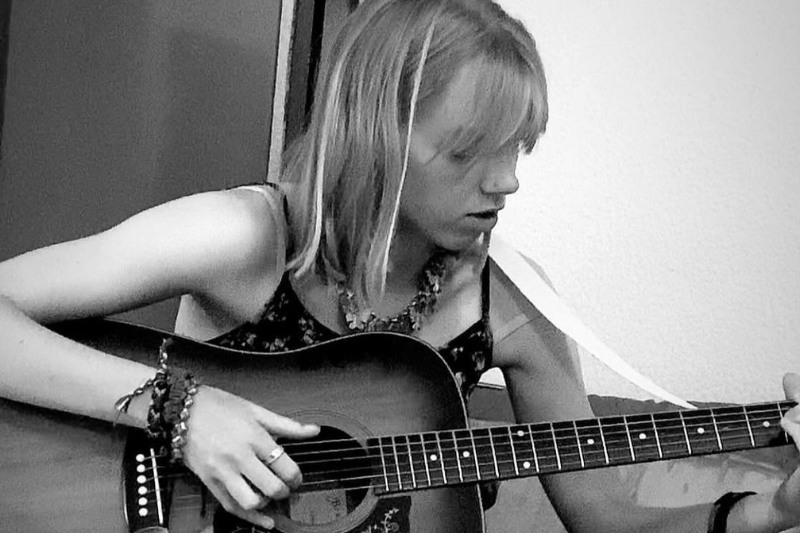
“I wanted to emulate that bedroom feel. I have this turntable which doubles as a radio, CD player and tape player. I wanted the album to feel like someone jumping between radio stations and records and things like that. Although now I listen back to it, I’m fairly sure you can faintly hear Martin Tyler in the beginning of Little Lives.” – Rebecca Spooner
Although she is one of several highly-talented young musicians in the Calder Valley – alongside the likes of The Incident, doogle, Rose Villas, The Caymans and others – Rebecca Spooner stands out in numerous ways.
For one, there’s the sinuous intricacy and maturity of her songwriting that belies her 19 years. Then there’s the versatility of her guitar playing, switching between finger-picking folk and pop chords with ease. And finally, her voice, through which she assembles rich harmonies and ornate counterpoints.
She has artfully combined all those elements in creating her debut album, Miss Belief.

Rebecca: “I always knew I wanted to release something by the end of my gap year, before I move out for university, so I recorded this album from February to July 2025 in my little bedroom studio in Todmorden.”
Rebecca is well known on the local gig circuit. She first came to prominence through the Golden Lion’s open mic nights. That quickly secured her a couple of high-profile support slots, one at the same venue, opening for The Lounge Society. She has since appeared at independent venues all over the borough and beyond on a regular basis, showcasing her ruminative, contemporary folk style.
That style is taken to a whole new level on her debut album, Miss Belief. The lavish treatment of its opening song Overture/Turning reveals a sound rarely glimpsed from her live sets. We find a delicate dabble of keys paving the way for a piece that is lush with layers and harmonics. The overall arrangement is bold and intriguing, with elements of Anna B Savage and Midlake woven into a tapestry of assured warmth.
Rebecca: “Turning was one of the first songs I wrote. I recorded it when I was around 14 on a Tascam DP-006 8-track recorder that my uncle had given me. By re-recording it for the album, it’s like a tribute to my younger self, back when I first started songwriting and producing. It also plays nicely into the themes of the album – growing up, alterations and moving forward.
“When I’m writing songs, I always start with guitar or piano and lead vocals and then literally just build everything up from there, adding drums and synths and strings, using lots of free VST plugins like BBC Symphony Orchestra and Groove Agent. In fact, Overture was only ever going to be just piano but ended up resembling some kind of Lord of the Rings soundtrack. I do tend to get carried away with instrumentation. I imagine some of these songs played acoustically will sound quite different to people, but I’ve always loved the process of materialising all the ideas in my head and turning something simple into something more impactful, even if I don’t actually have a symphony orchestra behind me.”
On songs like Town, the second track on the album, Rebecca’s folk-led sentiments are expressed through a more buoyant pop vernacular. Play On My Mind Now is her strongest example of such popifications, with its melodious jangle reminiscent of Edie Brickell or daisy-chain neo-skiffle band Fairground Attraction. At other times, she leans more towards swooning ballads, bringing to mind the haziest shades of Suzanna Vega.
Rebecca draws on a broad repertoire of acoustic guitar techniques too – chords, picks, runs and slaps allow her to change tempo at will and give her songs bite and edge when needed. And she drops into scratchy analogue moments, just fleetingly, when you least expect it. Meanwhile, the storytelling is characterised by a quiet confidence. She unapologetically makes use of the everyday and, in doing so, turning it into something of greater significance, much like Alex G, Mitski or even Lana Del Ray.
Rebecca: “One of the most important things to me in songwriting is lyrics. I usually start by focusing on something small and go from there, like in I Don’t Believe in Much. It’s got a real focus on books, then I sort of expanded, looking at the bigger picture. You can compare nearly everything to some kind of human experience. I also tend to keep it quite conversational. I do love a bit of alliteration, something that I picked up from listening to the likes of Big Thief.”

The centre-piece to the album, Little Lives, pushes out into new realms, adding electric guitar and drums. It’s got that open-highway top-down feel of a War On Drugs romp or Fleetwood Mac chart belter. I Don’t Believe In Much skips along with carefree, travelling troubadour vibes. And Postlude Solitude is precisely that – a concluding orchestral piece that lays to rest an album of many impressive parts with a tone that is both breathtakingly mournful and gently cathartic.
Rebecca: “The last thing I did was choose the album title. I always love using puns and double meanings. I was scanning my lyrics, thinking of ideas. I mention ‘misbelief’ in track five and the title Miss Belief instantly came to mind. I think it really just sums up the album. With each song, there’s this alternation between the childish optimism of belief and the gloomy realism of adult life. So, depending on how you choose to hear it, the title could denote something pretty pessimistic, or something that almost resembles some sort of joyful children’s book protagonist. Definitely a cup half-full or half-empty situation.”
Follow Rebecca Spooner on Instagram for news of further releases and upcoming gigs.



Leave a Reply