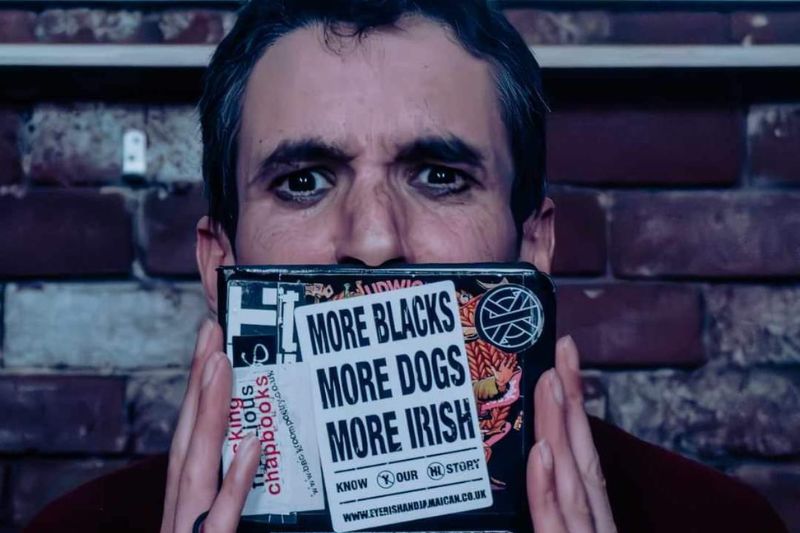
Kieron Higgins is fiercely proud of his Halifax heritage. His romantic loyalty to the region and the keen studious eye with which he observes it are evident in his writing.
But his genes are, in fact, spliced with a Jamaican-Irish ancestral past.
Keiron’s grandfather on his dad’s side was part of the Windrush generation. He came over during the 60s on his brother’s visa. His other grandfather was predominantly Irish – and a rugby league player and amateur boxer. Both men were apparently snappy dressers, enthusiastic socialisers and generally well known about town.
It all provides Keiron with a colourful past and ammunition for much of his poetic storytelling, something he has become rather good at, having developed a skill for penning sharp, sardonic musings on life, love and music in northern England.
We had the opportunity to dig deeper and ask Keiron about the many inspirations behind his literary work.

———-
DS: How would you describe the life of a modern-day poet in Halifax?
Keiron: “You hear words and verse in everything. You get to work with words that don’t pay very well but you get to dress how you like and listen to music. People are often afraid you can and will write about them. People consider everything you do is art.”
DS: Can you tell us about the regional inspirations for your poetry?
Keiron: “I’ve lived in Halifax for most of my life. You see a lot of the darkness and progress around here. During lockdown, I watched many 1960s kitchen sink dramas, which were filmed around grey northern towns, to inspire my writing. I consider Saturday Night, Sunday Morning a brilliant piece of working-class cinema. Both of my grandfathers were well-known and smartly dressed men from different experiences of life and I try to bring that experience aesthetically and physically with my performance – and often in my off-stage social appearance.”
DS: And what about your musical inspirations?
Keiron: “There are lots. Charles Bukowski, Daniel Johnston, Chet Baker, John Lydon, John Cooper Clarke, Mark E. Smith, Buck 65, Steve Ignorant, Linton Kwesi Johnson, Kool Keith, Henry Rollins, Mike Patton, Al Bowlly, Terry Hall.”

DS: When writing poetry, what part does music play in the creative process?
Keiron: “I was once asked,’What’s the difference between poetry and lyrics?’ The thing is, there isn’t any. Poetry is just the same but without a musical backing. You resonate with it because of how the person is talking to you and the tone of their voice. If you know a poet well, you can read their book in their tone of voice.
I once sang before I became a poet. Your ear hears a tone of music. If you are clever enough, you can improvise along to it. As I’m currently working with music again, people have been working around my voice to fit it to music. I talk at about 100mph on stage so it’s a challenge for them but the results so far have been pleasing.”
DS: Which lyricists do you consider the best? And what sets them apart?
Keiron: “As well as loving punk rock music, I also love early 90s hip hop. Two of the best from that genre are Kool Keith, for his imagination and the eccentricity of how his words flow, and more recently Buck 65. The latter comes from the other Halifax, in Canada. I also love the late, great Terry Hall. I’ve recently discovered a poet called Steven Jesse Bernstein from the US, who lived a fairly tragic life and died aged 40, but his output as a small-time poet affected many who knew him. I tend to like artists who’ve lived fairly interesting but sad lives.”
DS: Given unlimited super-powers, what would you do to make the world a better place?
Keiron: “Make teleporting and time travel a thing. With teleporting, although I can drive, there is often a shortage of trains and buses ‘up north’. With time travel, I’d be able to see the many bands and artists I have missed. Although, unlike the film Back to the Future, I’d try not to dabble with the past as that could have dire consequences.”
—–




Leave a Reply