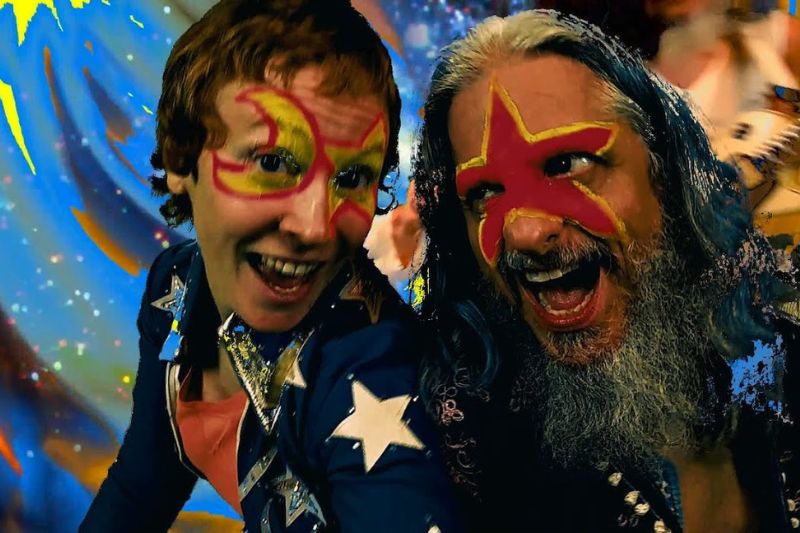
The bedazzling sensory overload that is Darsombra first came together around 2005. Comprised of Brian Daniloski and Ann Everton, and based in Baltimore, Maryland, they have crafted a succession of ambitious, transcendent releases and worked with notorious underground labels At A Loss, Public Guilt and Exile On Mainstream.
Seven albums in, their latest offering, 2023’s Dumesday Book, is by their own admission an attempt at a pop concept. They are renowned for dishing up gargantuan songs of 20 minutes or more. Two such epics is usually all they require to fill an album. But Dumesday Book is surprisingly different, spread across a more conformist 10-song palette.
That is, however, where any hint of normality ends.
On Dumesday Book, the galactic psych-rock duo maraud a path of wild sonic adventure. Deep, oscillating dronal rivers run amok. Flamethrower guitar highs are doused in squelchy dabs of affluent synth effects. It’s a ride. Their live experience – a cinematic, multi-dimensional feast – pushes the bounds of convention even further.
Darsombra’s music and performance art are reflective of their ultra-vivid outlook on life. Ahead of their gig at The Puzzle in Sowerby Bridge, we took a deep breath and sought out the two wide-eyed protagonists for a taste of their vision and verve.

DS: Can you tell us a little bit about the current DIY scene in Baltimore?
Ann: The legacy of John Waters and all the freaks before him remains strong. We saw a really enjoyable ‘found’ opera there this past winter. Independent art, music, theatre, cinema, writing and dance are as abundant in Baltimore as the crime tales that non-Baltimorons are so fond of telling me about – when I tell them I’m from Baltimore.
DS: Where have you found your sound resonates the strongest? What kind of culture or communities ‘get you’ the most?
Ann: Wherever people’s minds are open. We could have a killer show in rural Malaysia just as easily as in Seattle or Portland, Oregon. Or Portland, Maine, for that matter. A random smattering of cities I can think of, where folks have really dug the Darsombra experience, would include Wrocław and Krakow in Poland, Little Rock, Arkansas, Rapid City, South Dakota, Littleton, New Hampshire, Detroit, Michigan, San Luis Obispo, California, Tijuana in Mexico, Bandung in Indonesia, Winnipeg and Nanaimo in Canada, Inverness in Scotland.
DS: If you were given eternal super-powers, what three things would you do to make the world a better place?
Ann: One. All cops, government officials, leaders and military must take seven or more grams of psilocybin in a controlled therapeutic setting before becoming employed or engaged in their respective fields. Two. Alien intervention. It doesn’t have to be benevolent. There is nothing that will draw us together as a species like an alien invasion. Three. Culturally normalised non-monogamy or sluttiness. Promiscuity as a celebrated cultural ideal, regardless of gender identity.
Brian: I think just getting everyone to get along and stop fighting over stupid shit would be great. How about the superpower to instil a sense of empathy in everyone and then maybe everything else would work itself out?
DS: Could you describe how the two of you feed off each other, creatively speaking?
Brian: It’s almost as if we dare each other to go all the way with whatever creative whims the other one comes up with. How can we ramp it up and make it even more over the top.
Ann: I am a huge fan of peer review, particularly for independent artists. When you make your own work for your own pleasure, delightful as that is, things can easily become creatively stagnant if there isn’t someone around letting you know whether you’re on to something, or whether you’re full of shit. And, thankfully, we’re both very comfortable letting the other know how their work is shaping up. But that’s peer review. I used to rail against my art teachers in college during unfavourable critiques of my work. But would I still even be making art now, 20 years later, if it weren’t for that criticism?
DS: The last album, particularly a song like Call The Doctor, has a lot of ‘up-ness’ to it. Is that reflective of your personalities in general? Or circumstances around how you felt at the time?
Ann: For me, that song is actually more about the unhinged manic celebration many of us inadvertently faced when we found out we couldn’t go back to our jobs during the initial Covid lockdown…
We are both mostly energetic, up-energy people, sans caffeine, even. But all reaching and no rooting can get you into trouble so we make a point to remain grounded as best we can. A song like Call the Doctor… we wrote it as a party-in-a-can: you open it up and for 15 minutes, you feel energised and thrilled, especially if you’re audacious enough to try dancing to the whole song.

Brian: We both tend to have positive, can-do attitudes about life, but all the while trying to remember to not take anything too seriously. I have to laugh a little whenever I see a band promo photo or video and they’re all scowling or trying to look tough. It comes across as sort of ridiculous to me, but then I seem to be on the opposite side of a lot of stuff, as many music fans seem to respond more positively to that sort of posturing, and probably think we come across looking like a couple of goofballs. I’m okay with that. At least I’m being true to myself.
DS: Can you share your thoughts on the current financial climate for bands and artists? Is the ‘struggle’, real?
Ann: The struggle is real, but it’s always been that way. DIY ethics are extremely helpful for artists desiring creative freedom, if – and that’s a big, big, big if – they aren’t afraid of frugality, keeping a low overhead, having a side hustle, as we call it in the States, or many side hustles, learning to live on less.
We are not complete misers, but we rarely buy new clothes, for example. In the US, you have to actively disconnect from the consumer culture that is compulsively conditioned by varying outlets as normalcy. It’s not just the ads on TV, the internet, or the radio, it’s your friend’s post on Instagram about their new lawnmower, or bike, or farm-to-table meal as well. So if you’re not looking for the fur coats – unless, of course, you found a cheap one at a secondhand shop – and the bathtubs of champagne – unless, of course, you grew the grapes and made the champagne and bought a foreclosed house with a tub – DIY approaches can be very gratifying, liberating and worthwhile.
Brian: There were a lot of promoters and venues, well below the mainstream radar, that existed to serve the bands way down in the under-underground, that didn’t make it through 2020-21. So for us it was almost like starting from scratch. We exist on a very independent, DIY, cottage industry level, and while it feels comfortable for us to work this way, I don’t recommend it for everyone, unless you want to get down and dirty and do a lot of hard work yourself.
We are purposely choosing to make this weird, obscure music. I guess if we wanted things easier we could do a cover band, or start a karaoke business, but we have other sources of income and we keep our cost of living as low as possible, so our art can be free from the expectation of it having to support us, which in turn allows us to be as weird and obscure with it as we wish. I always find the most profound art is usually made by someone who feels compelled to make it whether or not they are getting paid for it anyway.
DS: What are you most proud of?
Ann: Today, Dumesday Book. We put a lot of love into that album. I hope folks enjoy it as much as we enjoyed bringing it to life.
Brian: Oh, probably just proud of the legacy of Darsombra. That a project like this could last as long as it has, playing what is coming up on 1,000 shows and having the opportunity to perform all over the world and put out cool music and videos with this little project that basically started in my bedroom.
Quickfire questions – ‘This Or That’
Sunrise or sunset?
Ann: Sunset.
Brian: I love both, but because of the nature of my work, I am usually not awake to witness the sunrise, unless it’s been a really, really late night.
Rebellion or meditation?
Ann: Meditation.
Brian: I think we need both. I don’t think meditation is the opposite of rebellion. I meditate on how I’m going to rebel.
Animals or plants?
Ann: Fungi
Ghosts – real or ridiculous?
Ann: Real
To teach or to learn?
Ann: Learn.
Brian: You can’t teach properly until you’ve learned. I like learning more than teaching. Teaching is a whole other skill set that requires good people skills. Just because one is good at something doesn’t mean they can teach it well.
Sound or vision?
Ann: Vision.
Brian: You’re making this tough. Our band tries to meld sound and vision.
Fire or water?
Ann: Water.
Brian: Water.
Studio or live?
Brian: Live is where one gets the visceral experience. Studio is like a postcard or painting of an awesome landscape. Live is being in that landscape.
Realism or idealism?
Ann: Realism.
Brian: As a yoga student and teacher I would say that striving towards a balance of these things would be the most important. Realism will impose itself no matter what, but without idealism there is no hope, and what is life without hope?
– – – – – – – –
Image credit: Julia Vering


