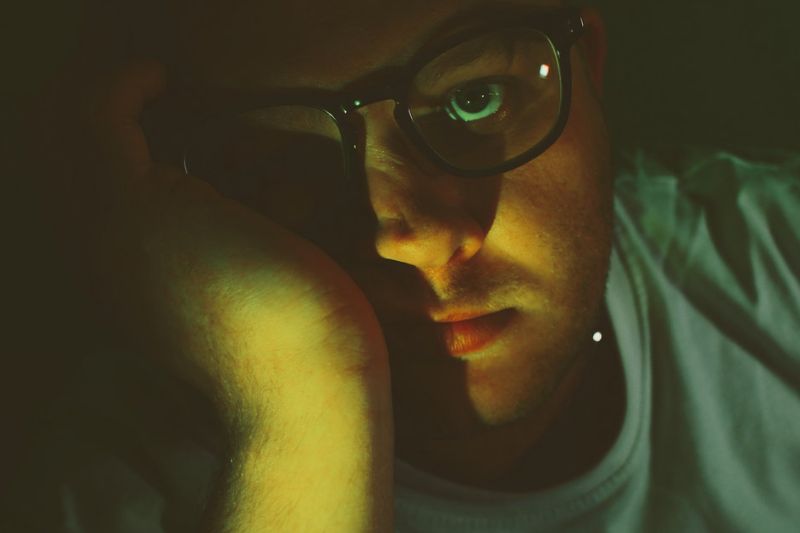
Fat Frances, aka Rory Johnson, has gone stratospheric for his latest single, hiring in the expertise of a legendary US record producer.
Gordon Raphael is internationally renowned as the man behind The Strokes’ first two albums, Is This It and Room On Fire. He has also handled production duties for Regina Spector, The Wildhearts and Hinds, and has worked in varying capacities with Damon Albarn, Ian Astbury and Ian Brown. Quite the CV!
Fat Frances’ new release, It’s Not Rock’n’Roll, bears the marks of Gordon’s mercurial touch. It’s oozing confidence and charm, full of foot-stomping, indie-rock swagger.
To find out more, I caught up with Rory and his drummer, Jason Walters, at The Golden Lion where they were playing a support slot to John J Presley. I was keen to hear how the opportunity to work with Gordon Raphael first came about.
Jason: “I know Gordon through work and I just hit him up and asked him. I expected him to say ‘no’. I mean, he’s super-famous. But he was gracious enough to give us his time. It was very cool. Straight away he was up for it. Then I sent him some of Rory’s stuff to listen to and he was like ‘Yes! Definitely!’ He’s just the nicest guy. We were with him for a day. Then we did some revisions. Rory was in constant contact with him for a couple of weeks until it was finished. And he did it all for mates’ rates. It was crazy really. You don’t get that every day.”

Rory has ramped up his own knowledge of the recording process exponentially over the past three years, releasing three albums in that time, each one more sophisticated and accomplished than the last. But working the controls alongside an award-winning US producer has taken his understanding and appreciation of the production arts to a whole new level.
Rory: “It showed me how much more I’ve got to learn. When I’m recording, I’ll be chin-scratching and sometimes spend two weeks on a track thinking ‘there’s something missing here’. Gordon just knows, within seconds. He’ll be like ‘I need this exact mic’.”
The track in question, It’s Not Rock’n’Roll, follows on from last year’s Oyster album – a sumptuous, woozy, melodic gaggle of off-kilter, indie cuts that demonstrated a leap in Rory’s songcraft, as well as his production capabilities.
Rory: “For Oyster, I did everything on a Tascam 12. The laptop I had at the time wouldn’t run Cubase properly, so I got a Tascam and mixed it all on there. It was the steepest learning curve. It’s harder than playing an instrument. There’s loads of maths to it. I just never really thought about recording that much before. It was always such an abstract concept. You’d have a microphone somewhere or you’d plug a lead in somewhere and just hit ‘record’ and it’d be fine. You think it just captures what you hear. But it’s not like that at all. The first few attempts I made were not good, not to my standard, so I’ve had to learn through trial and error.”
Jason: “I think it’s made Rory a better songwriter. He considers the whole song now, the whole arrangement. Rory was never getting the recording quality he wanted from other people. It didn’t really match what he was trying to do. So, in time, he’s just developed that himself – the recording side of things.”
Rory: “The flip side of that is playing live again. When you’re recording, you know you can add drums here, bass there, more keys. But trying to make the songs work retrospectively, when it’s just guitar and drums, is a challenge. Some songs are piano-led on the album. So that’s a real interesting challenge for me. Like, how can I take a song like Terror, that’s really chilled out on the album, and make it pretty raucous.”
It’s Not Rock’n’Roll is something a little different to anything on Oyster. There’s more energy and beef to the overall approach, which isn’t entirely down to Gordon Raphael’s influence.
Rory: “I wrote It’s Not Rock’n’Roll just after I’d finished recording Oyster. I thought ‘Oh my god, should I put this on the album?’ It had just come to me and I really liked it. But the album was its own thing and I didn’t feel like I could tag it on at the end.”
Rory, it seems, is never short of ideas. They flow through him. He currently has three new, separate music projects in mind. In search of inspiration for the next sound, his musical tastes reach far and wide.
Rory: “Right now I’m really interested in swing and big bands. Bobby Darin! Beyond The Sea is my karaoke go-to. It’s the perfect song. I think, if you could get that really swingy riff, not as brass but as fuzzy guitar or organs or something, that would be the end goal for me.”
Rory and Jason are understandably keen on working with Gordon again, but admit there may be logistical hurdles to overcome – “I’d love to, but we need to make some more money first,” offers Jason. Even at mates’ rates, award-winning record producers don’t come that cheap.
That said, there has perhaps never been a better time for such collaborations to form. The Valley is rich with artistry, attitude and a DIY ethos that, if nurtured, has the potential to create a genuine movement. Discussing the merits of the current music scene in the Calder Valley, Rory and Jason clearly believe there is an opportunity lying in wait.
Rory: “It’s a bit of a double-edged sword. Everyone knows everyone but at the same time it doesn’t really feel like a scene. Everyone’s an island, getting gigs in isolation. But look at Manchester in the 80s, Seattle in the 90s. There are so many people here doing cool stuff. Why can’t it be here?”
Jason: “There’s not a local sound right now. If you look at CBGS or places like that, they created a sound. That’s what I’d want from the young people in places like Tod – to get their heads together and say ‘what can we do?’ There are some, like Working Men’s Club, they have a really interesting sound, and The Lounge Society, they do some really interesting stuff. But I’d like to see young people create together and build something here for themselves.”
Support the artist
Listen to Fat Frances on bandcamp and follow on Instagram for latest news on gigs and future releases.
Words & media: Stephen Desmond
Photo: Matty G


